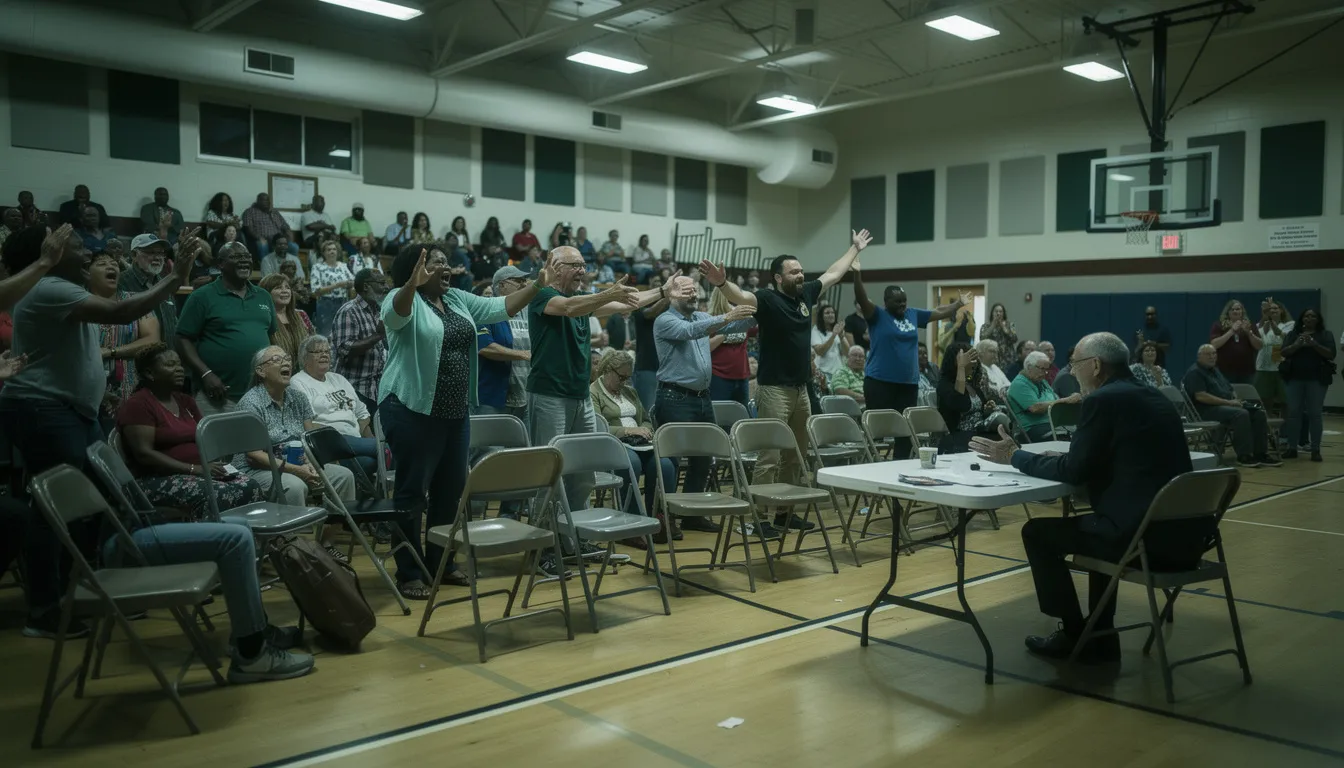
BEND, OR — A town hall meeting convened Thursday evening to discuss a proposed roundabout at the intersection of Third Street and Greenwood Avenue devolved over the course of three hours into what urban planning experts and theologians are jointly describing as “a secular altar call.”
The meeting, hosted by the Bend City Council in the cafeteria of Marshall High School, began with a standard presentation on traffic flow data. By the ninety-minute mark, residents had moved past the roundabout entirely and begun delivering impassioned testimonials about the meaning of community, the loss of small-town identity, and, in one case, a lengthy confession about a property line dispute from 2018.
“A woman stood up, walked to the microphone, and said, ‘I just need to say something I’ve been carrying for a long time,’” said city manager Tom Aldridge, 52. “Then she talked for nine minutes about a fence. People were nodding. Someone said ‘amen.’ I don’t know how we got here.”
“By the end, three people had come to the front of the room. Two were crying. I was holding a zoning map like it was Scripture. It was the most powerful municipal meeting I have ever attended.”
Aldridge offered the above account, adding that he had “no training for this” and that he found himself saying “thank you for sharing that” in a tone he described as “involuntarily pastoral.”
Dr. Karen Whitfield, 58, a professor of political science at Oregon State University who studies civic engagement, told reporters that secular altar calls are “more common than people think” and tend to occur “whenever a microphone is placed in front of a community that hasn’t been listened to in a while.”
The roundabout was approved unanimously during a brief procedural vote that no one seemed to notice.
At press time, Aldridge had received four handwritten thank-you notes and one resident had asked if the city council could “meet like this every week, but maybe with coffee.”