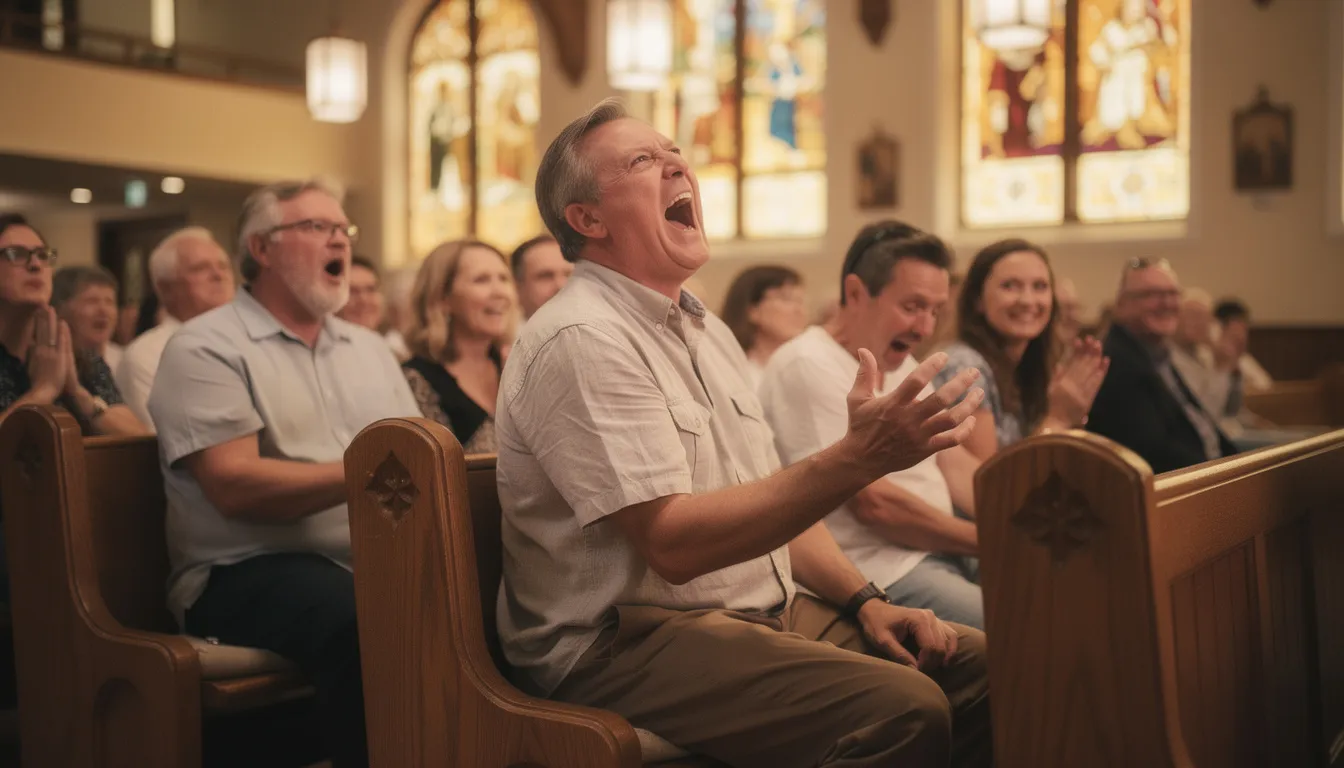
Every Sunday, roughly six to eight times per sermon, I say “Amen.” I say it with my full chest. I say it from the fourth row, where I have sat for nineteen years. I say it loud enough that the sound guy once checked the monitors because he thought there was feedback. I am aware that this startles people. I do not care.
My wife has asked me to “bring it down a notch.” The head usher has spoken to me twice. A woman I do not know handed me a note last Easter that read “Please consider others.” I considered them. I continued.
Let me explain something. When the pastor says something true — genuinely, scripturally, bone-deep true — my body responds. It is involuntary in the same way blinking is involuntary. I cannot not say it. The word rises from somewhere near my sternum and exits at a volume I have never fully controlled. This is not a choice. This is a calling.
“David danced before the Lord with all his might. He did not check to see if anyone was uncomfortable. If David can dance in a linen ephod, I can say ‘Amen’ in a polo shirt.”
Last Sunday, the pastor was making a point about grace and I said “AMEN” with enough force that he lost his place in his notes. He looked at me. I nodded. He found his place. We moved on. That is how it works. That is the covenant between a preacher and a man in the fourth row who is fully locked in.
I have been told that my amens are “disruptive.” I reject this. Disruption is a phone going off during prayer. Disruption is a toddler throwing Cheerios at the choir. What I offer is affirmation. Verbal, immediate, percussive affirmation. The early church did not sit in silence. They shouted. They wept. They said “Amen” like they meant it. I mean it.
At press time, the pastor had begun pausing briefly before his strongest points, which I choose to interpret as him giving me time to prepare.